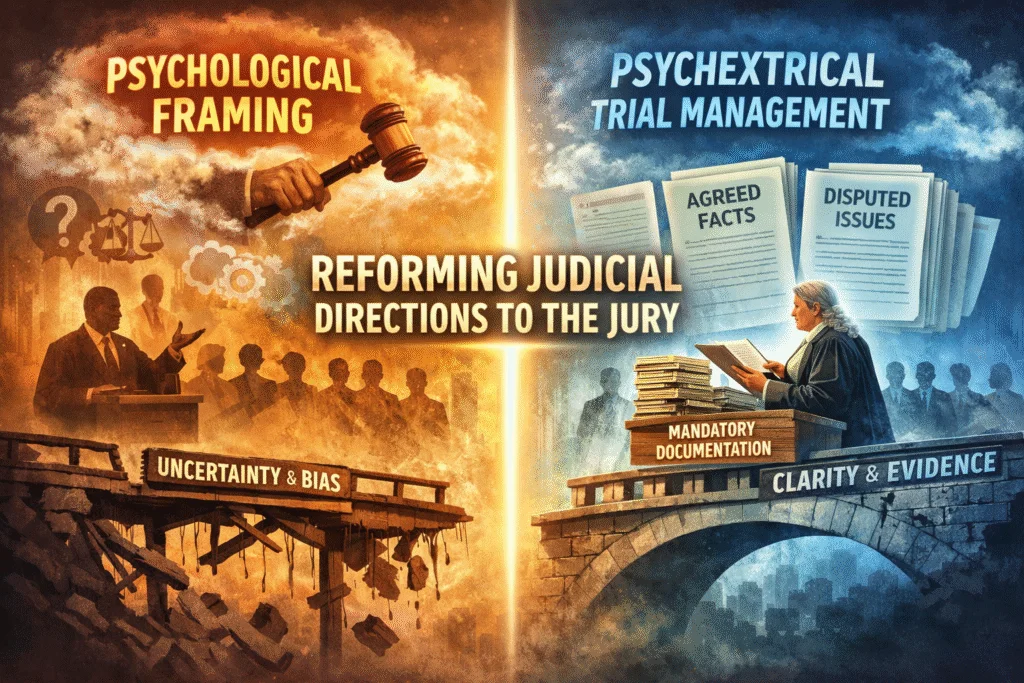
In every jury trial there is a moment often treated as routine, even ceremonial: the judge’s summing-up and directions to the jury. It is presented as neutral guidance. It is understood as a safeguard. It is framed as clarification.
Yet in practice, this stage is the hidden arena where subtle misdirections—however unintended—can enter the narrative bloodstream of a trial.
This is not a personal critique of judges. It is a structural observation. The issue is not character, but design. In an adversarial system built on contest and persuasion, the judge’s direction to the jury functions as the final narrative consolidation. If that consolidation is not structurally disciplined, psychological framing can quietly eclipse evidential architecture.
The reform question is not whether judges are impartial. It is whether the current structure sufficiently protects against narrative drift.
1. The Structural Faultline
The modern jury trial operates on two parallel planes:
- Evidential structure — what is formally proved, agreed, or disputed.
- Narrative psychology — how those elements are framed, sequenced, emphasised, or contextualised.
- Blend agreed and disputed facts.
- Elevate opinion to parity with established evidence.
- Frame relational context in ways that subtly privilege one side’s narrative architecture.
- Compress complexity into psychological shorthand.
If reflective cognition varies across individuals, then the assumption that a single reflective synthesis can safely structure juror cognition is scientifically fragile. The trial must therefore be psychextrically structured—not psychologically curated.
2. The Problem of Untethered Direction
At present, judicial directions are guided by precedent, specimen directions, and appellate oversight. Yet there is no mandatory structural framework requiring:
- Explicit documentation of all agreed facts.
- Clear segregation of disputed issues.
- A tabulated evidential map distinguishing fact from opinion.
- A visible, numbered burden-of-proof pathway.
Even subtle language choices matter:
- “You may think…”
- “It might be said…”
- “You will recall…”
When jurors are left to reconstruct what was common ground and what was contested, deliberation becomes memory-driven rather than structure-driven. Memory is reconstructive, not reproductive. It is vulnerable to emphasis effects, recency bias, and group reinforcement dynamics.
This is not a criticism of jurors. It is a recognition of human cognition. And we are all complicit on matters of psychological embellishment of narratives.
3. A 21st Century Reform: Psychextrical Trial Management
The reform question is therefore structural:
- Should courts require explicit articulation of all undisputed relational facts?
YES. - Should juries be formally directed to treat agreed facts as their starting framework?
YES. - Should opinion evidence be tightly filtered where it contradicts established common
ground?
YES—subject to disciplined procedural safeguards.
A. Mandatory Documentation of Agreed Facts
Every trial—criminal or civil—should begin and end with a numbered, written schedule of Agreed Facts. This document should:
- Be settled before closing speeches.
- Be read to the jury.
- Be provided in writing for deliberation.
- Be expressly identified as the starting framework.
B. Mandatory Documentation of Disputed Issues
Disputed facts must likewise be:
- Narrowly defined.
- Numbered.
- Explicitly tied to elements of the offence or claim.
- Clearly connected to the burden of proof.
- Did X occur?
- If so, did the defendant know Y?
- Has the prosecution proved Z beyond reasonable doubt?
C. Opinion Must Not Eclipse Fact
Opinion evidence—whether expert, professional, or narrative—must be structurally constrained where it contradicts established common ground. Reform should require that where opinion conflicts with agreed fact:
- The conflict be explicitly identified.
- The jury be directed that opinion cannot displace established fact unless the factual basis itself is challenged.
- The evidential hierarchy be made visible.
D. Visible Burden of Proof
The burden of proof must not merely be stated—it must be structurally embedded. Each disputed issue should be accompanied by an explicit reminder:
“The burden rests on the prosecution to prove Issue 2 beyond reasonable doubt.”
Not once in general terms—but repeatedly, issue by issue.
The burden of proof is not atmospheric. It is granular. When it becomes abstract, it becomes psychological.
E. Mandatory Contextual Transparency in Conviction Certification
A further stabilising reform concerns what happens after the verdict.
Under the current framework, a conviction certificate typically records only the offence of conviction. It is a stripped conclusion — a legal label devoid of context. It does not disclose what was agreed, what was disputed, or upon which structured issues the jury deliberated. The result is a formal outcome detached from the evidential architecture that produced it.
Under psychextrical trial management, this must change. Every conviction certificate should be accompanied by the jury’s:
- Mandatory Documentation of Agreed Facts, and
- Mandatory Documentation of Disputed Issues,
This does not require disclosure of jury deliberations. It requires disclosure of the structural framework within which deliberation lawfully occurred.
Wherever a conviction certificate is requested — for sentencing review, appeal, professional regulation, offending behaviour course, probation risk management, immigration decisions, employment vetting, or public record — the contextual schedule must follow it as a matter of course.
This reform serves several stabilising functions:
- Prevents Narrative Inflation: A bare conviction label invites reinterpretation and exaggeration over time. Context constrains distortion.
- Preserves Evidential Integrity: It makes visible what was actually in dispute and what was not. A conviction does not imply that every allegation advanced was proved.
- Strengthens Appellate Review: Appellate courts can assess whether judicial directions aligned with documented agreed and disputed issues, rather than reconstructing the framework retrospectively.
- Protects Against Administrative Overreach: Regulatory or collateral bodies relying on conviction records would be required to engage with the structured evidential basis, not merely the offence title.
- Anchors Democratic Transparency: Justice must not only be done but be structurally traceable. A conviction without context is a conclusion without architecture.
If trials are to be disciplined by documented common ground and documented contest, then convictions must carry that architecture forward. A verdict is not merely a word. It is the endpoint of a structured pathway. Psychextrical trial management insists that the pathway must travel with the outcome.
4. The Myth of Reflective Superiority
The traditional model assumes that the judge’s reflective synthesis offers cognitive stability. But reflection is not uniform. Even research in psychometrics and cognitive science demonstrates:
- Variability in abstraction levels.
- Variability in narrative integration.
- Variability in framing sensitivity.
If judicial direction relies heavily on reflective narrative integration rather than structured evidential mapping, it risks becoming a psychologically dominant voice rather than a procedural stabiliser. Structure disciplines authority.
5. From Psychological Trial to Structural Trial
The adversarial system functions best when:
- Common ground is documented, numbered, and explicit.
- Disputed issues are narrow, documented, numbered, and explicit.
- Opinion does not eclipse fact.
- The burden of proof remains visible at each analytical step.
- Precise rather than expansive.
- Anchored rather than interpretive.
- Evidential rather than narrative.
Transparency demands that the Conviction Certificate is accompanied by the same documented common ground and documented contest relied in jury deliberation.
6. Preventing Miscarriage Without Personal Blame
This proposal does not accuse judges of bias. It merely recognises a systemic vulnerability: Psychological framing thrives in unstructured spaces.
Where “Agreed Facts” and “Disputed Facts” are formally documented and supplied to the jury, the judge’s summing-up cannot roam free. It must operate within defined coordinates.
The role of judicial direction shifts from narrative synthesis to evidential navigation. That is reform through discipline—not distrust.
Conclusion: Stabilising the Adversarial System
The adversarial system is indispensable in democratic society. It relies on contest. It relies on persuasion. It relies on narrative. But it must also rely on structure.
If agreed facts are invisible, if disputed issues are amorphous, if opinion bleeds into established ground, and if the burden of proof becomes atmospheric, then the jury trial drifts toward psychological arbitration rather than structured adjudication.
Requiring explicit documentation of common ground and contested ground is not radical. It is overdue. Psychology belongs to advocacy. Structure belongs to justice.
A 21st century jury trial must be psychextrically disciplined—anchored to explicit frameworks that prevent narrative dominance from displacing evidential clarity.
These are not partisan suggestions. They are procedural stabilisers. And stabilisers are what preserve justice from drift.